SCIENCE
SIGNIFIGANCE OF LUNAR SCIENCE
One of the biggest challenges of establishing a Lunar Base is the extremely harsh radiation environment. Unlike the Earth, the Moon does not have an atmosphere and a magnetic field able to absorb or deflect energetic solar particles and galactic cosmic rays which strike undisturbed the lunar surface. The radiation environment on the lunar surface is made even more complex by the interaction of the primary cosmic rays with the regolith atoms which can generate albedo, secondary particles emitted from the soil.
- How does this environment depend on the solar activity?
- What is the influence of the geological features of the surface (craters, lava tubes) have on this environment in terms of shielding and albedo emissions?
These are the main scientific questions Lunar Zebro will answer. The ultimate goal is to deploy a swarm of mini rovers which could provide an accurate map of the radiation environment on the Moon surface and help the future astronauts to build the shelters which can protect them.
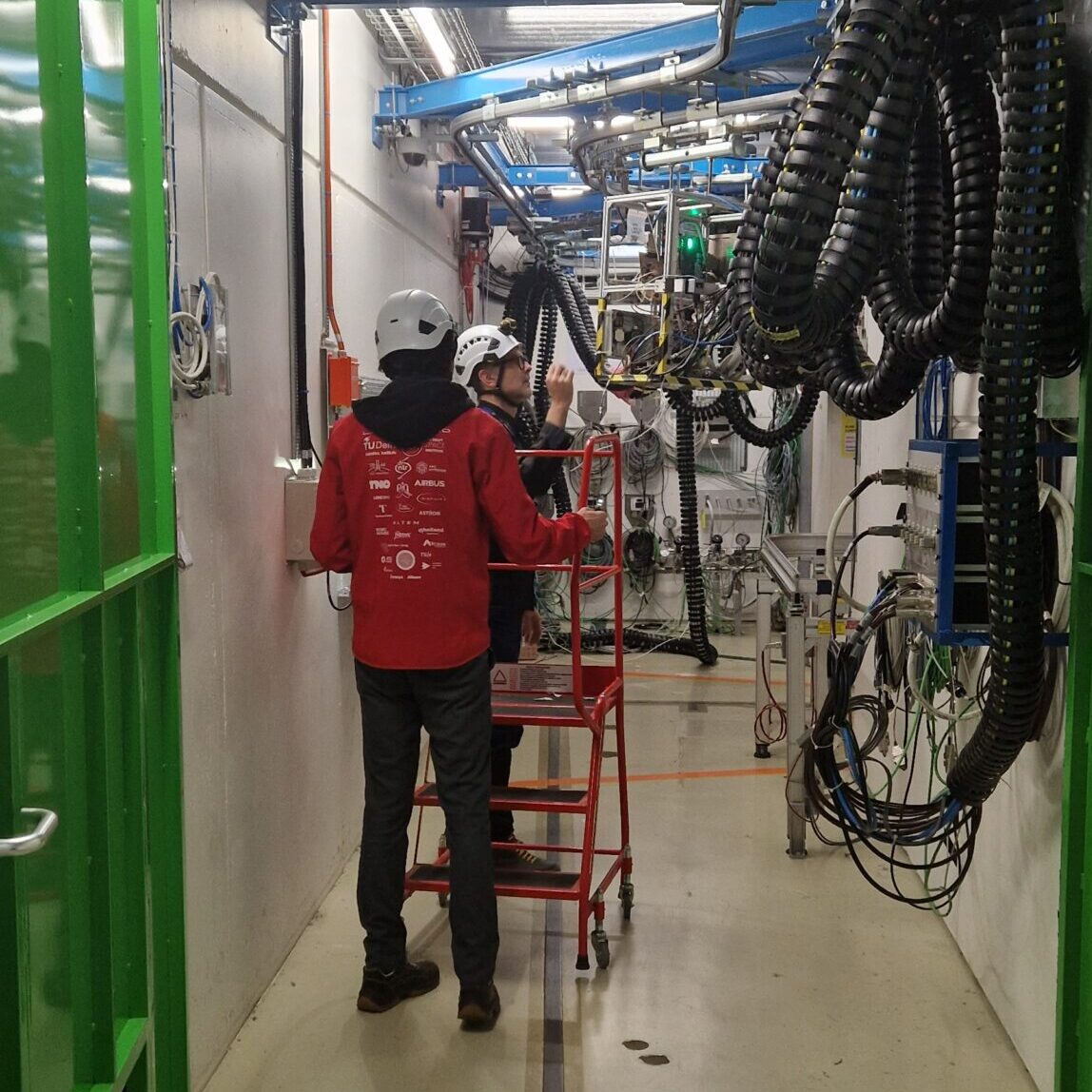
The Lunar Zebro team at CERN CHARM, retrieving the payload from the facility
RADIATION
With Lunar Zebro we want to contribute to fill this gap by measuring the radiation environment on the moon surface with an on-board highly miniaturized radiation sensor. The instrument will acquire a unique data-set of measurements taken at different locations which would allow us to understand the shielding capabilities of the lunar landscape. The ultimate goal is to deploy a swarm of mini rovers which could provide an accurate map of the radiation environment on the Moon surface and help the future astronauts to build the shelters which can protect them.
Objectives:
- To design, manufacture and operate a miniaturised radiation payload able to characterise accurately the radiation environment on the Moon surface
- To deploy identical radiation payloads on multiple rovers to obtain an unprecedented map of the radiation environment on the Moon surface
Research
The first generation of the Lunar Zebro radiation payload, REDMOON (Radiation Environment and Dose Monitoring On-board a Nano-Rover), has been developed based on the Floating Gate Dosimeter (FGDOS). The payload was designed to enable in-situ radiation measurements on the lunar surface within the strict constraints of a nano-rover platform. As part of this work, the instrument was calibrated using a proton beam at HollandPTC. This research was carried out as part of the MSc thesis “REDMOON: Radiation Environment and Dose Monitoring On-board a Nano-Rover” by Abhimanyu Shanbhag.
This research was subsequently extended by Stan Broere in his MSc thesis, “Characterising the Lunar Radiation Environment Using the Floating Gate Dosimeter”. In this work, the response of the Floating Gate Dosimeter to low-intensity gamma radiation was investigated, representing radiation levels expected during nominal lunar surface operations. In addition, mixed-field radiation experiments were conducted at the CERN CHARM facility to study the behaviour and robustness of the payload in a complex radiation environment.
Radiation Monitoring
The research areas our team focus on are:
- Design, assembly, integration and testing of miniaturized radiation sensors
- Calibration of radiation sensors with particle beams and fixed field sources.
- Data analysis of radiation sensors
- Monte-carlo simulation of the radiation sensors in realistic shielding and environment conditions
Principal Investigator